
How to Evaluate Ceiling Fan Airflow: Understanding CFM, RPM, and Wattage
When shopping for a ceiling fan, you may notice that two fans with the same size and speed have different airflow ratings. You may also find larger fans that spin more slowly yet move more air.
So, does a higher fan speed always mean more airflow? Does higher wattage necessarily mean better performance?
Not necessarily.
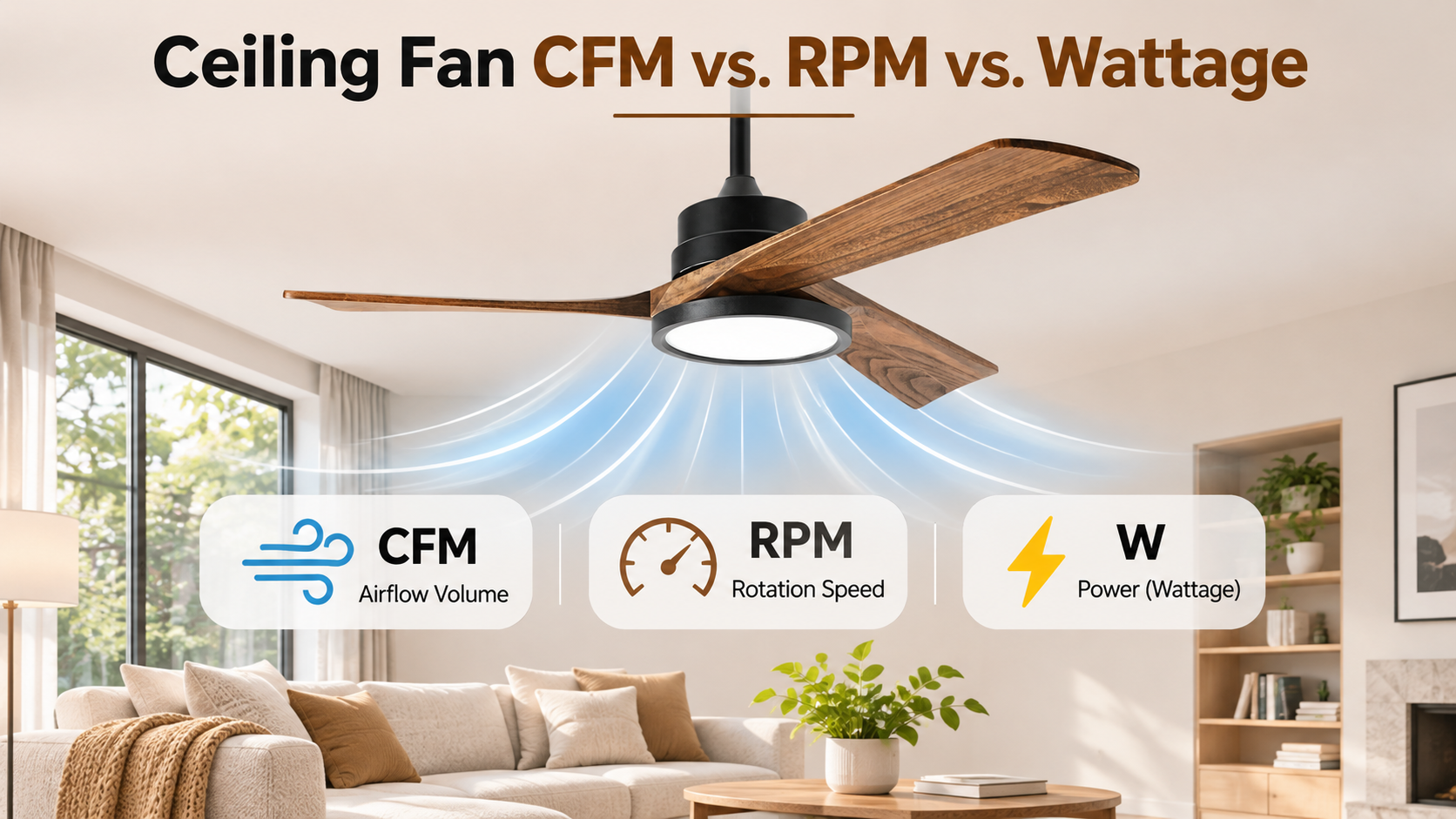
CFM, RPM, and wattage measure different aspects of ceiling fan performance. CFM describes airflow volume, RPM measures blade rotation speed, and wattage relates to electrical power. These figures are connected, but they are not interchangeable.
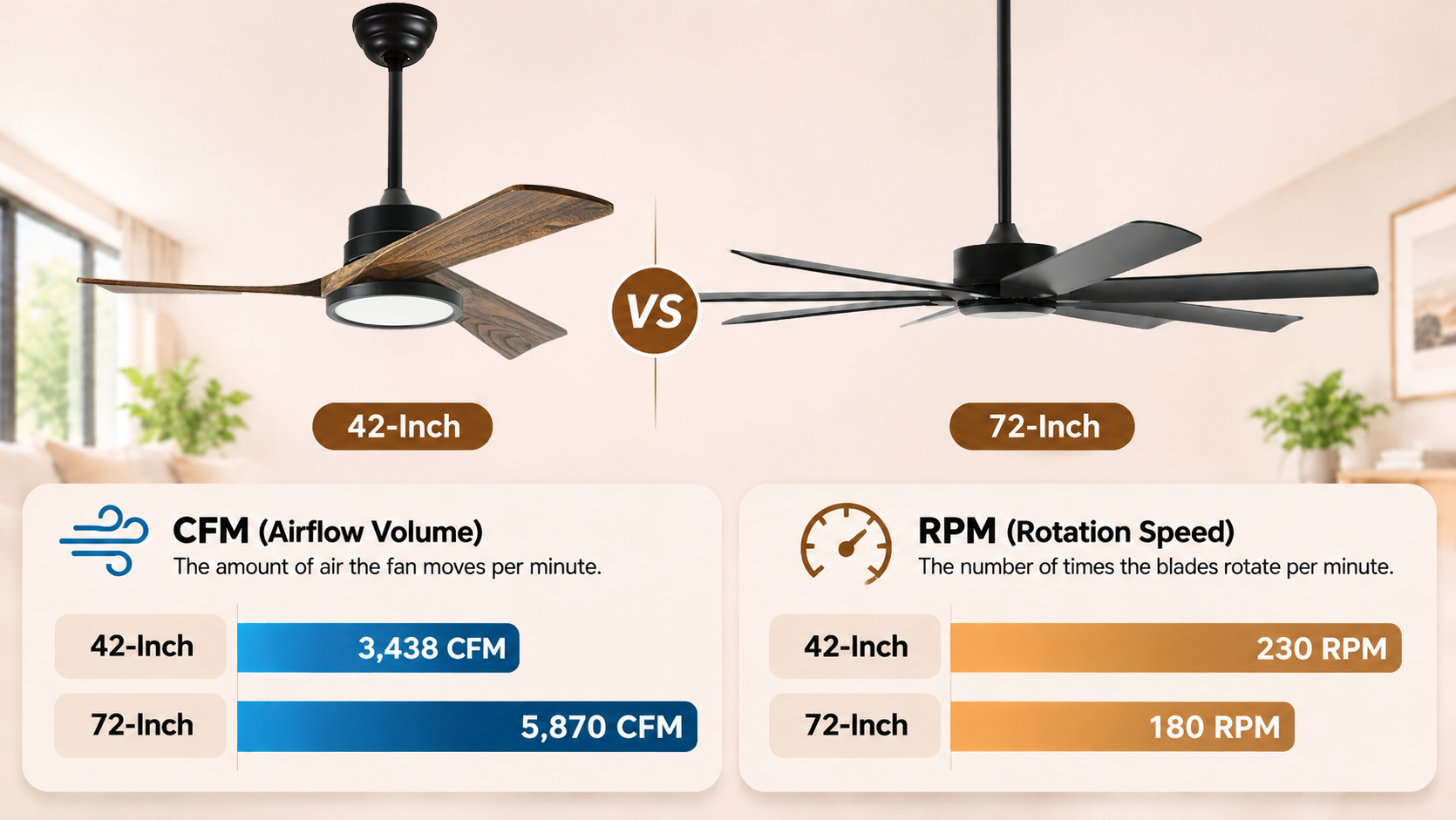
For example, CeilingFanHub’s 42-inch W2352P328944 has a listed maximum speed of 230 RPM and maximum airflow of 3,438 CFM. The 72-inch W2352P221668 is rated at only 180 RPM, yet its listed maximum airflow reaches 5,870 CFM.
How can a slower-spinning fan move more air?
This guide explains these specifications and compares three ceiling fans currently listed on CeilingFanHub to help you understand CFM, RPM, and wattage—and use them to choose a fan that fits your needs.
Quick Answer: What Do CFM, RPM, and Wattage Mean for Ceiling Fans?
CFM, RPM, and wattage refer to airflow volume, blade rotation speed, and electrical power, respectively.
CFM: Measures the volume of air a fan moves per minute and indicates its airflow capacity.
RPM: Measures how many revolutions the blades make per minute. It indicates speed, but not airflow on its own.
Wattage: Measures power. Actual input wattage, together with operating time, can be used to calculate electricity consumption.
If airflow capacity is your main concern, start with CFM. If electricity use matters most, look for actual input wattage. In either case, first choose an appropriate fan size based on your room and installation conditions.
1. What Do CFM, RPM, and Wattage Measure?
Before comparing ceiling fans, it helps to understand the three specifications most commonly found on product listings.
| Metric | Full term | Meaning | Primary use |
|---|---|---|---|
| CFM | Cubic Feet per Minute | Air volume moved per minute | Compare airflow capacity |
| RPM | Revolutions per Minute | Blade rotations per minute | Understand rotation speed |
| W | Wattage | Electrical power in watts | Understand power demand |
1.1 CFM: How Much Air Can a Ceiling Fan Move?
CFM stands for cubic feet per minute. It measures the volume of air a fan moves each minute.
For example, a fan rated at a maximum of 6,000 CFM moves approximately 6,000 cubic feet of air per minute under the corresponding test conditions.
Generally, when testing conditions are the same or comparable, a higher CFM indicates greater airflow capacity.
However, two fans with the same CFM may feel different depending on their size, mounting height, and airflow distribution.
CFM is therefore useful for assessing airflow capacity, but it does not determine comfort by itself.
1.2 RPM: How Fast Does a Ceiling Fan Spin?
RPM stands for revolutions per minute—the number of times the blades complete a rotation in one minute.
A rating of 230 RPM means the blades rotate 230 times per minute.
On the same fan, increasing the speed will generally increase air movement. Across different models, however, a higher RPM does not necessarily mean a higher CFM.
Airflow also depends on fan diameter, blade shape, width, pitch, and overall design.
RPM tells you how fast a fan spins, but it cannot independently establish which model moves more air.
1.3 Wattage: Does More Power Mean Better Performance?
Wattage measures electrical power in watts (W).
If you know a fan’s actual input wattage while running, you can estimate its electricity use from the operating time.
A higher wattage does not automatically mean greater airflow.
Two fans with the same rated motor wattage may have different CFM figures. Conversely, a fan with greater airflow does not necessarily require higher input power. For fans with lights, lighting consumption also matters.
In short: CFM describes airflow volume, RPM describes rotation speed, and actual input wattage describes power demand.
2. Understanding CFM and RPM Through Real Product Specifications
Now that the three measurements are clear, let’s see how they differ across actual products.
We selected three CeilingFanHub models and used their listed specifications for two comparisons of CFM, RPM, and wattage.
These comparisons address two questions:
Does a faster-spinning ceiling fan always move more air?
Why can two fans with the same size, blade count, RPM, and rated motor wattage have different CFM ratings?
The figures below come from existing product specifications; they are not new measurements taken under identical test conditions.
Case Study 1: Does Higher RPM Always Mean More Airflow?
First, compare a 42-inch ceiling fan with a 72-inch model:
| Specification | 42-inch fan | 72-inch fan |
|---|---|---|
| SKU | W2352P328944 | W2352P221668 |
| Diameter | 42" | 72" |
| Blade count | 3 | 8 |
| Rated maximum CFM | 3,438 | 5,870 |
| Rated maximum RPM | 230 | 180 |
| Rated motor wattage | 35W | 50W |
According to the listed specifications, the 72-inch model runs at a maximum of 180 RPM, below the 42-inch model’s 230 RPM. Yet its rated maximum airflow is 5,870 CFM versus 3,438 CFM—approximately 70.7% higher.
This illustrates how a slower-spinning fan can still have greater airflow capacity.
Why does this happen?
Fan size is one important factor. A larger diameter generally creates a larger swept area as the blades rotate, which can allow a fan to move more air at a lower speed.
However, these two models also differ in blade count and design, so the airflow difference cannot be attributed to size alone.
The key takeaway is simple: do not use RPM alone to decide which ceiling fan moves more air.
When comparing fans of different sizes, consider room dimensions and installation requirements first, then compare CFM rather than simply choosing the fastest-spinning model.
Case Study 2: Why Can Two Fans With the Same Size and RPM Have Different CFM Ratings?
Next, consider two 42-inch fans, each with three blades and a rated motor wattage of 35W.
| Specification | W2352P328944 | W2352P221669 |
|---|---|---|
| Diameter | 42" | 42" |
| Blade count | 3 | 3 |
| Rated maximum RPM | 230 | 230 |
| Rated maximum CFM | 3,438 | 4,200 |
| Rated motor wattage | 35W | 35W |
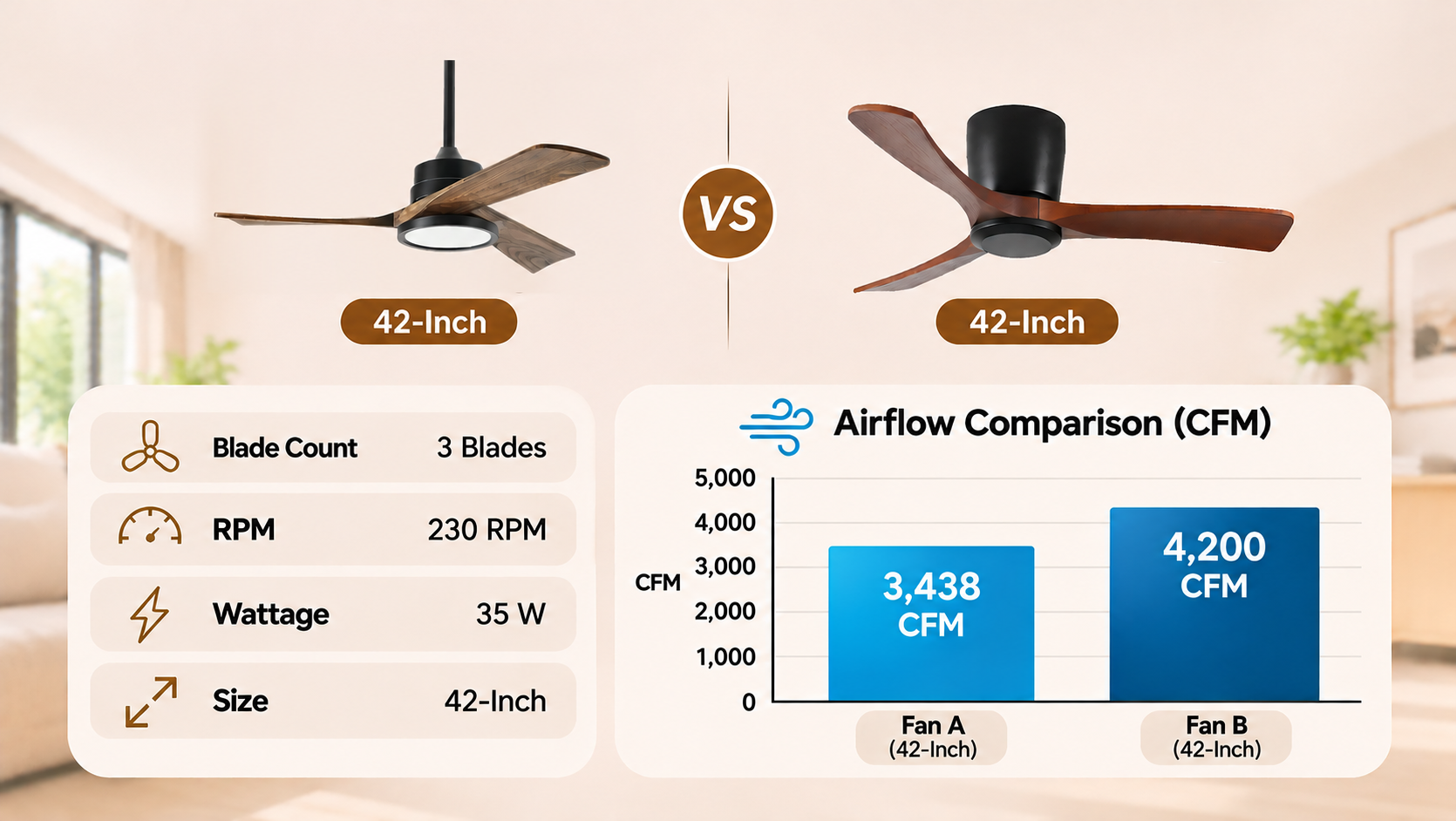
Both fans have the same diameter, blade count, listed maximum RPM, and rated motor wattage, but their rated maximum airflow differs by 762 CFM. At 4,200 CFM, W2352P221669 is approximately 22.2% higher than W2352P328944 at 3,438 CFM.
Even when size, blade count, RPM, and rated motor wattage match, airflow ratings can still differ.
What factors can affect CFM?
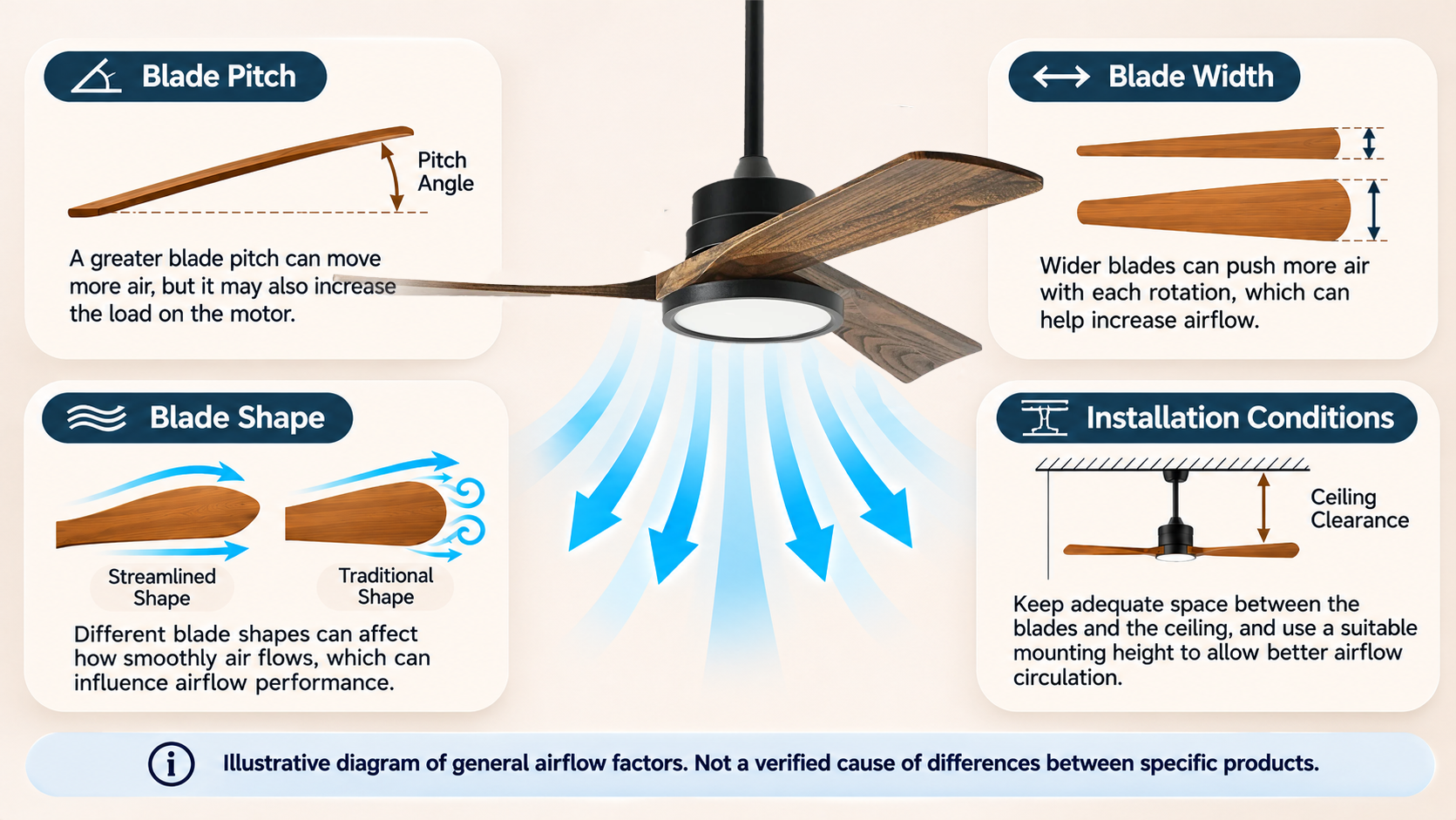
First, ceiling fan blade pitch matters. Pitch affects how rotating blades interact with the air. Different pitches change how air is pushed, but a steeper pitch does not automatically produce more airflow; motor load, speed, and other design factors also play a role.
Second, blade shape and width can influence airflow. Differences in blade profile, curvature, and width can produce different aerodynamic behavior, even at the same fan diameter.
Blade-to-ceiling clearance, installation conditions, overall construction, and motor operating characteristics may also influence airflow performance.
These figures do not prove that any particular blade design is better. They do show why CFM is generally a more direct indicator of airflow capacity than RPM alone when comparing similarly sized fans.
If you are choosing a 42-inch fan, check that each model suits your installation space, then compare airflow and features rather than focusing only on blade speed.
3. What Is CFM/W, and How Do You Evaluate Airflow Efficiency?
In addition to CFM and RPM, you may see CFM/W in ceiling fan specifications.
CFM/W measures airflow delivered per watt of power, making it an important indicator of ceiling fan energy efficiency.
When test methods and data are comparable, a higher CFM/W generally indicates more air moved for each watt of electricity consumed.
You can also check whether a product carries an applicable ENERGY STAR efficiency certification. For fans with lights, consider the lighting energy use as well.
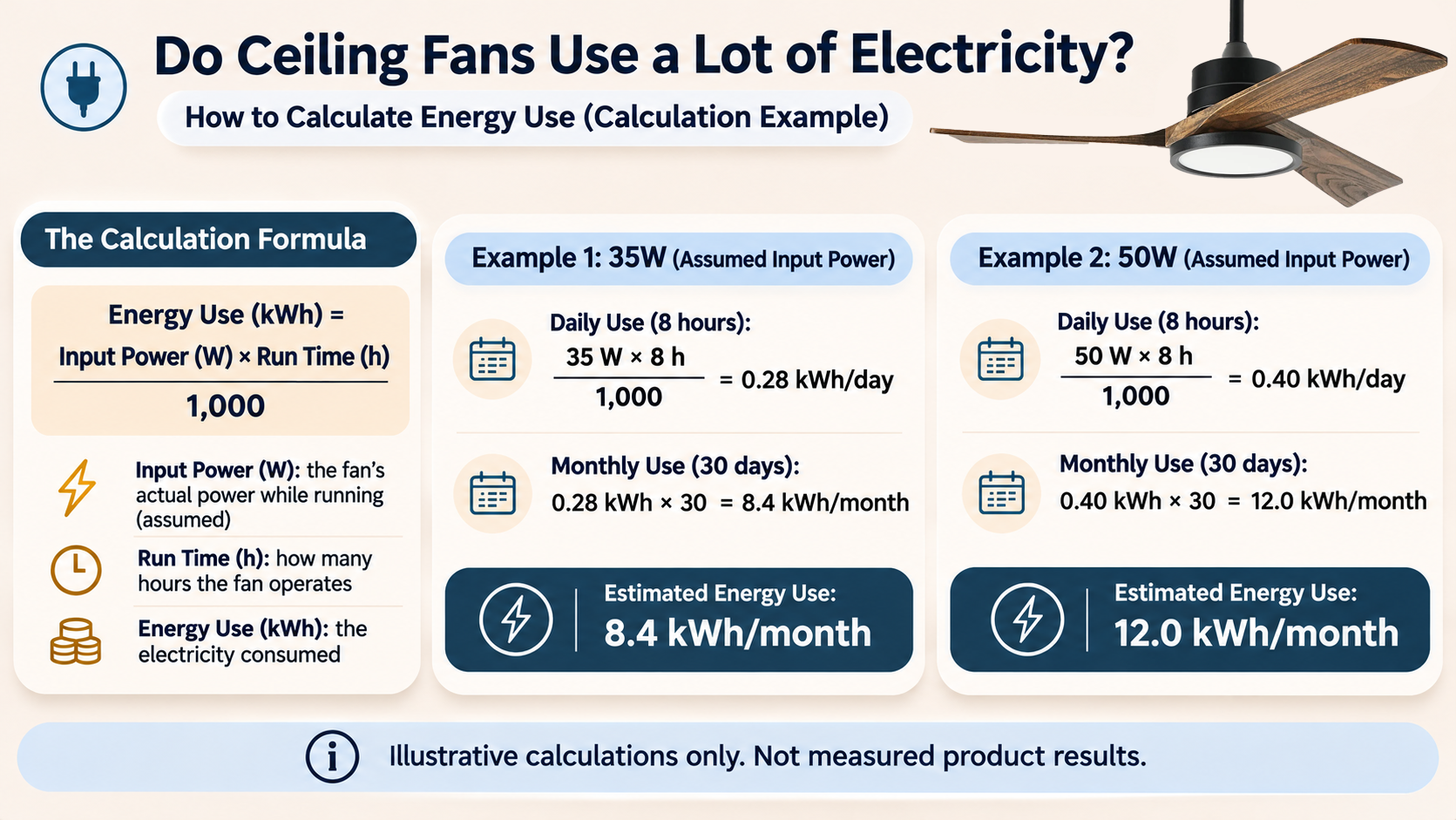
Do Ceiling Fans Use a Lot of Electricity? How to Calculate Energy Use
If you know the actual input power while the fan is running, use this formula:
Suppose a fan runs at an actual input power of 35W for 8 hours a day over 30 days:
If another fan runs at an actual input power of 50W over the same period:
| Assumed actual input power | Consumption per day (8 hours) | Consumption over 30 days |
|---|---|---|
| 35W | 0.28 kWh | 8.4 kWh |
| 50W | 0.40 kWh | 12 kWh |
These are illustrative calculations, not measured electricity consumption for the three products compared here.
If a fan’s light is switched on at the same time, its electricity use must also be included.
4. Should You Look at CFM, RPM, or Wattage First When Buying a Ceiling Fan?
Once you understand these numbers, shopping becomes easier. Rather than looking for a single “best CFM” for every room, follow these four steps.
Step 1: Choose a Fan Size for Your Room
Consider room area, ceiling height, and available installation space to identify a suitable fan-size range.
For example, 42-inch and 72-inch fans may serve different spaces. A higher CFM does not automatically make a fan the better choice for your room.
For help choosing a size, read our Ceiling Fan Size Guide.
Read the Ceiling Fan Size Guide →
Step 2: Compare CFM Among Similarly Sized Fans
After narrowing down the size, compare airflow capacity.
The two 42-inch fans above both list a maximum speed of 230 RPM, but their rated maximum airflow figures are 4,200 and 3,438 CFM. If airflow capacity matters most, CFM is generally the more direct specification to compare.
Step 3: Consider Wattage and Energy Efficiency
If both fans meet your airflow needs, compare their actual input wattage and CFM/W figures obtained under comparable testing conditions.
Also consider how many hours you expect to run the fan each day and whether you will regularly use its light.
Step 4: Match the Fan to Your Everyday Needs
Different buyers prioritize different aspects of performance.
| Main priority | What to compare | What to keep in mind |
|---|---|---|
| Airflow capacity | CFM | An initial indicator of how much air a fan moves |
| Performance at different speeds | High- and low-speed airflow | Check whether performance suits your habits |
| Energy efficiency | Actual input wattage; CFM/W | Do not judge efficiency by rated motor wattage alone |
| Comfort | Airflow distribution; mounting height | CFM is not the same as air speed at your location |
CeilingFanHub Product Recommendations
W2352P221668 | 72-inch ceiling fan without light
A good option for larger spaces if you prefer a full-size fan without an integrated light.
W2352P221669 | 42-inch ceiling fan without light
Suits shoppers who prefer a clean, simple look and do not need additional lighting.
W2352P328944 | 42-inch ceiling fan with light
A practical choice if you want everyday lighting and air circulation in one fixture.
5. Frequently Asked Questions
1. Which Matters More for Ceiling Fans: CFM or RPM?
For comparing airflow capacity, CFM is more direct. RPM describes blade speed, but fans vary in size and design, so speed alone cannot establish airflow.
2. What Is a Good CFM Rating for a Ceiling Fan?
There is no single number that suits every room. First choose a size that fits your room and installation conditions, then compare CFM among similarly sized models. Maximum CFM may not reflect airflow at the speeds you use every day.
3. Does Maximum CFM Tell You the Airflow at Low Speed?
No. Maximum CFM represents peak airflow under specific test conditions, not airflow at low or medium speed. If you often use a lower setting, look for airflow figures for that speed.
4. Does a Higher-Wattage Ceiling Fan Always Use More Electricity?
At the same operating time, a higher actual input power results in greater electricity use, assuming that power remains constant. However, rated motor wattage may differ from real operating power and should not be used alone to estimate a model’s electricity cost.
5. Does Higher CFM Always Make a Room Feel Cooler?
Not necessarily. CFM measures airflow volume, while the breeze a person feels also depends on local air speed, mounting height, and airflow distribution. A high CFM does not guarantee the same breeze everywhere in a room.
6. Conclusion: Look Beyond a Single Performance Number
CFM, RPM, and wattage describe airflow volume, rotation speed, and electrical power demand.
The specifications of these three CeilingFanHub fans show that speed, size, and rated motor wattage cannot independently determine airflow capacity.
The most practical approach is to choose a fan size that fits your room, compare CFM and energy efficiency, and then account for your daily needs and installation conditions.
If you are looking for a fan for a living room, bedroom, or another space, browse the CeilingFanHub collection and compare sizes, airflow ratings, and features to find a model that suits you.


